Electricity Never Forgives a Shortcut: Demystifying Ground Paths, Arc Faults & Code-Compliant Branch Circuits
Over 85% of DIY electrical mishaps stem from two preventable mistakes: confusing LINE with LOAD on safety devices, and failing to verify neutral pathways before installing switches. Every protocol here is cross-referenced with the National Electrical Code (NEC) to keep your family safe and your home fully insurable.
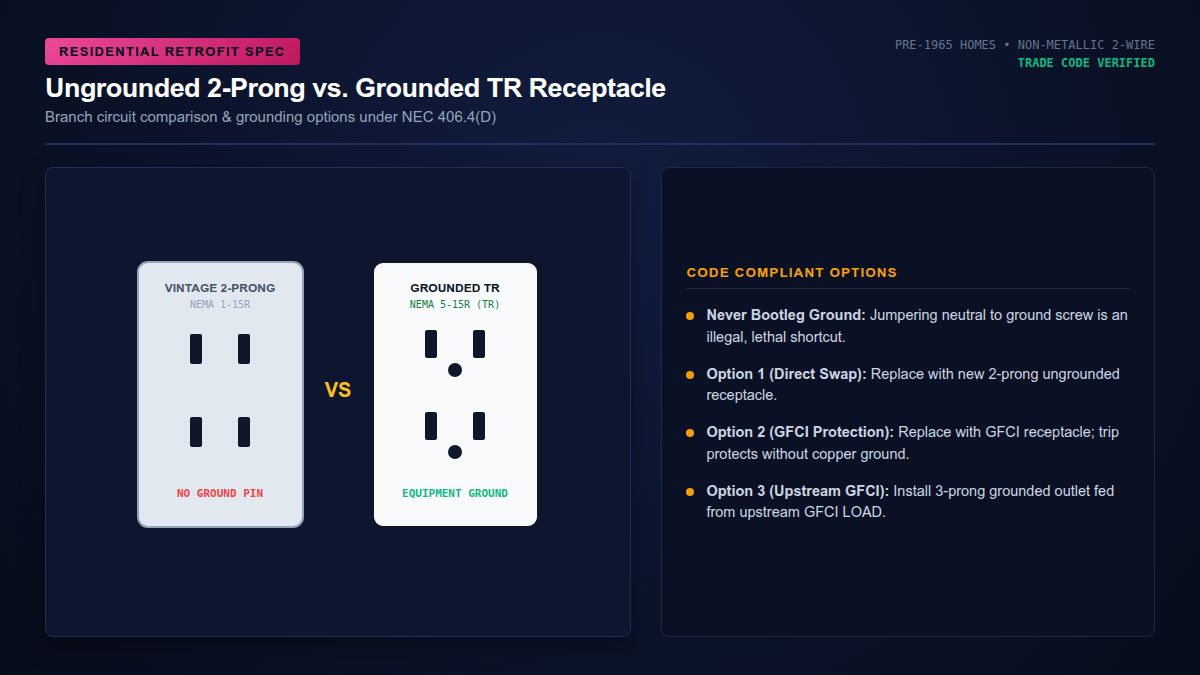
How to safely install modern 3-prong grounded outlets in 1950s homes without running new copper through plaster walls using GFCI protection.
Updated October 2026 • 7 min read • NEC Article 406.4
NEC 210.19 & 314.16 Sizing Protocol
Branch Circuit Wire Gauge & Box Fill Estimator
Calibrated for 120V US Residential Systems
Select your circuit parameters to verify required conductor gauge, maximum continuous wattage under the NEC 80% rule, voltage drop over distance, and minimum junction box volume.
Minimum Conductor
14 AWG Solid Copper
(White Romex Sheath)
Max Continuous Load
12 Amps (1,440W)
NEC 80% Safety Rating
Voltage Drop Est.
0.8% (Well within 3% limit)
NEC 210.19(A) Note 2
Min Box Fill Volume
18.0 cu. in.
Deep Plastic / Steel Box
Field Note from Mike Sterling: 15-Amp circuits are standard for general bedroom lighting. Never connect 14 AWG wire to a 20-Amp breaker — the wire becomes an unprotected fuse if overloaded. Always match breaker size to the smallest wire gauge in the circuit run.