Converting Ungrounded 2-Prong Outlets: The Code-Compliant NEC 406.4(D) Retrofit
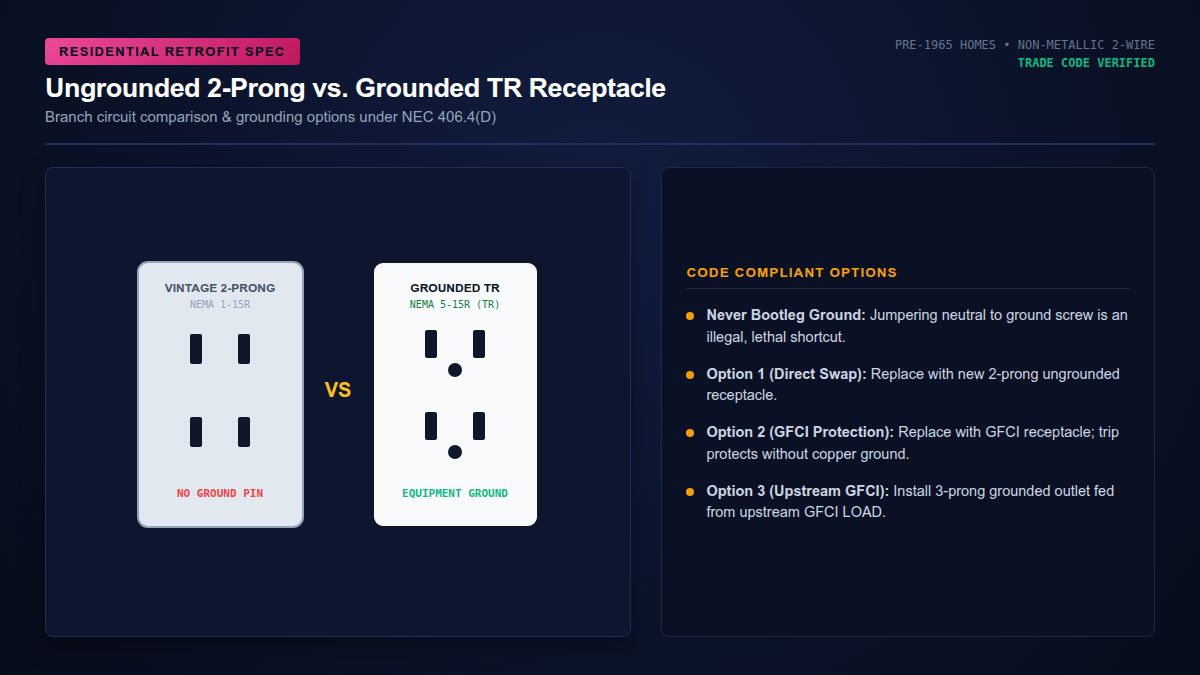
Millions of homes built in the United States prior to 1965 were wired with 2-wire non-metallic cable (black hot and white neutral, with no bare copper equipment grounding conductor) or cloth-jacketed BX armored cable. When homeowners want to plug in 3-prong grounded appliances, computers, or television soundbars, they face a common dilemma: rewiring the house with modern 12/2 Romex costs thousands of dollars in wall tearing and electrician labor.
The most dangerous and illegal DIY shortcut is buying a standard 3-prong outlet, installing it into the ungrounded box, and either leaving the green ground screw floating or jumpering the ground screw to the neutral screw (a lethal practice known as a bootleg ground). If the neutral wire ever loosens upstream, the metal chassis of every connected appliance becomes energized with live 120 volts.
The 3 Legal Code Options Under NEC 406.4(D)(2)
The National Electrical Code specifically accommodates vintage homes through NEC 406.4(D)(2), which outlines the only three permitted methods for replacing ungrounded receptacles:
- Option A (Like-for-Like): Replace with another non-grounding (2-prong) receptacle. These are still manufactured and sold at electrical supply houses specifically for this purpose.
- Option B (GFCI Protection at the Outlet): Replace the 2-prong receptacle with a GFCI receptacle. Even without a grounding conductor, the GFCI coil detects current leakage between hot and neutral and will trip instantly if someone touches a live fault.
- Option C (Upstream GFCI Feed): Replace the 2-prong receptacle with a standard 3-prong grounded-type receptacle, provided it is fed from the LOAD side of an upstream GFCI receptacle or protected by a GFCI circuit breaker in the panel.
Mandatory Code Labeling: "No Equipment Ground"
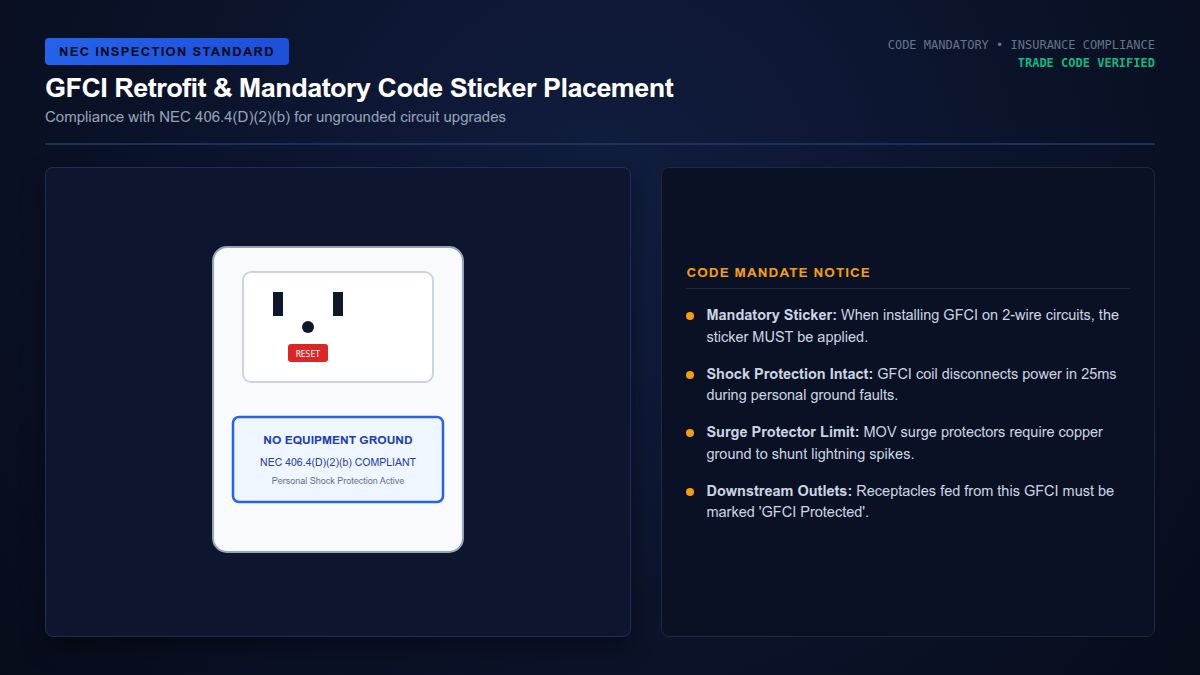
When you install a GFCI receptacle on an ungrounded 2-wire circuit (Option B), or install standard 3-prong outlets downstream of a GFCI (Option C), the National Electrical Code mandates that you apply the stickers included in the GFCI box:
- On the GFCI itself: Affix the sticker marked "NO EQUIPMENT GROUND" directly to the cover plate or receptacle face.
- On downstream 3-prong outlets: Affix both "GFCI PROTECTED" and "NO EQUIPMENT GROUND" stickers.
How to Wire a GFCI Receptacle: Distinguishing LINE from LOAD
Branch Circuit Wire Gauge & Box Fill Estimator
Select your circuit parameters to verify required conductor gauge, maximum continuous wattage under the NEC 80% rule, voltage drop over distance, and minimum junction box volume.